Browse by family
Silk Scarves
Neck scarves for daytime, travel and evening occasions.
Wool Scarves
Scarves for outdoor settings and daytime outings.
Cashmere Scarves
Scarves for evening occasions and gift lists.
Silk Shawls
Shawls for occasions that call for a lighter layer.
Cashmere Shawls
Shawls for evening occasions and travel days.
Wool Shawls
Shawls for outdoor settings and daytime outings.
Cashmere Wraps
Wraps for evening occasions and travel days.
Silk Fabric
Fabric for buyers planning scarf lines of their own.
Polyester Scarves
Scarves listed in the company's Alibaba shop, at category level.
Silk Pillowcases
Pillowcases listed in the company's Alibaba shop, at category level.
Silk Pajamas
Sleepwear listed in the company's Alibaba shop, at category level.
Custom Silk Scarves
Scarves ordered to a buyer's own brief.
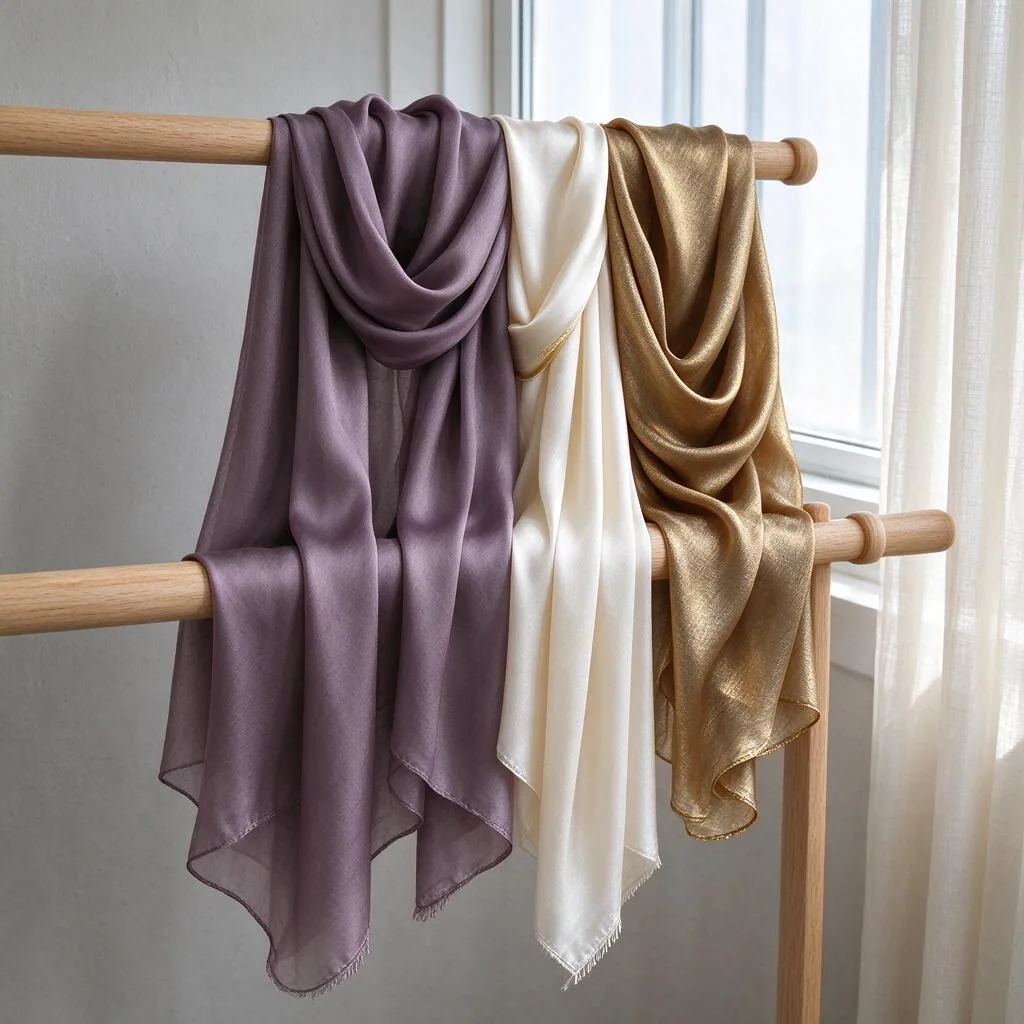
Start from the family, then the use
The families on this site fall into three groups: scarves, shawls and wraps, and silk fabric. Within each group, the useful split is the setting and the occasion. A scarf for daytime outings and a scarf for evening occasions sit in different lists, even when they share a family name. Start with the family page, note the setting, and build the item list from there.
Colour, shape and size words appear in search terms for these families, and buyers often arrive with a colour or a shape in mind. This site publishes no colour, size or shape claim for any item. Name the colour, shape and size requirements in the inquiry, and ask what applies to each item on the list. The inquiry is the place where those requirements belong.
What sits behind each family page
Each family page names the family at category level and gives selection guidance: the settings the family serves, the occasions buyers name most often, and the questions to include in an inquiry. Family pages do not list individual designs, and they do not present one item as representative of a whole family. Where a family is listed only in the company's Alibaba shop, the page says so at category level and keeps the same inquiry framing.
Guide pages work differently. A guide page explains how to sort a choice and what to settle in writing, and it never presents its subject as a supplied product. The head scarf guide, the pillowcase guide and the sleepwear guide are written this way. Read a guide page before the family page when the choice itself is still open.
Wholesale and custom inquiries
Wholesale pages and custom pages use the same inquiry shape as the family pages: an item list, quantities, a destination market, and anything to settle in writing. Wholesale pages cover scarves and shawls in larger lists. Custom pages cover scarves ordered to a buyer's own brief. In both cases, the brief belongs in the inquiry, with the item list first and the open questions listed beside each item.
No page on this site states a minimum order figure or a lead-time figure. Put quantities and timing questions in the inquiry, beside the items they belong to, and keep the item list and the questions together in one message.
Reading the guide pages first
Guide pages exist for choices that are still open. When the family is settled but the shape, the grouping or the requirements are still open, the guide page for that family sorts the open questions before the inquiry is written. The cashmere scarf guide sorts shape and colour questions for cashmere lists. The shawl guide sorts the choice between shawls, wraps and wrap shawls. The pillowcase guide and the sleepwear guide sort size and shape questions for lists at category level. The fabric guide sorts planned-use questions for fabric lists. The custom scarf guide sorts brief questions for custom lists. The head scarf guide sorts style requirements for buyers whose lists include head scarf styles.
Read the guide page, note the questions it raises, and carry those questions into the inquiry beside the items they belong to. A guide page read after the inquiry is written helps the next list, not the one already sent. The order matters: guide first, list second, inquiry third. Buyers who skip the guide step often find the inquiry harder to write, because the open questions surface only when the message is half written.
The inquiry shape, step by step
The inquiry shape is the same on every page of this site, and it runs in five steps. First, write the item list, one line per item, described in the buyer's own words. Second, group the list: by family, by setting and occasion, or by planned use, whichever grouping the list calls for. Third, put the quantity beside each item, in the buyer's own terms. Fourth, name the colour, shape and size requirements beside the items they belong to, and add the design requirements where the list is a custom list. Fifth, name the destination market for the list as a whole, and add anything to settle in writing beside the items it belongs to.
Keep the five steps in that order when writing, and keep the finished message in that order when reading it back. A message written in inquiry shape reads clearly from the first line: the reader sees the groups, then the items, then the quantities, then the requirements, then the market and the open questions. A message written out of order can still carry the same facts, but the reader has to rebuild the grouping before the questions can be placed.
Lists that span families
Lists that span families are the common case for wholesale buyers and for buyers building gift lists, and they need one extra pass before sending: the family pass. Read the list once for family boundaries alone, and mark each item with its family. Silk scarves, wool scarves, cashmere scarves and polyester scarves each form a group. Silk, cashmere and wool shawls each form a group. Wraps form a group of their own, and wrap shawls form a group between shawls and wraps. Pillowcases, sleepwear and fabric each form a group of their own.
After the family pass, read the list once more for settings and occasions, and mark each group with the setting and occasion it belongs to. Two groups can share a setting and still stay separate groups, because the occasion or the family differs. The two passes together give the list its shape: families first, settings and occasions second, requirements third. The inquiry pages for wholesale lists give the same two passes for larger lists.
What this site does not state
This site states no colour, size, shape or specification claim for any item, and it states no claim about any design method. Colour, shape and size requirements belong in the inquiry, named beside the items they belong to. This site states no minimum order figure and no lead-time figure; quantity and timing questions belong in the inquiry, beside the items they belong to. This site states no founding year and no years figure, and it publishes no phone number and no contact person. The location is given at city level only: Hangzhou, Zhejiang, China.
Certificates are the one exception to the pattern, and the line is fixed: certificates are available upon request. Put any questions about certificates, which are available upon request, in the inquiry, beside the items they belong to. The brand-name presentation on the homepage carries its attribution in the sentence itself, and this site carries no brand story beyond that sentence. Every other fact on this site is a family name, a grouping, or an inquiry instruction, and nothing else is claimed.
Keeping the record together
An inquiry is a record as well as a message, and the record works only when its parts stay together. Keep the item list as sent beside the questions that belong to it, with the quantities beside each item and the requirements beside the items they belong to. When the list changes, send the changed list as a whole, with the questions carried beside the items they belong to, so the record stays in one place. A partial change sent as a fragment splits the record between two messages, and a question in one message can lose the item it belongs to in the other.
If you receive a confirmation, keep it with the quote, beside the list it belongs to. Keep the list, the quantities, the requirements and the confirmation together in one record, and use that record when the items are checked on arrival. The habit costs nothing at the time of writing and saves the whole inquiry from being rebuilt from fragments later. Start every list on this site with that record in mind: groups first, items inside groups, quantities and requirements beside the items they belong to, and everything in one message.
The record habit also steadies lists that grow over time. A list that starts short and grows across several messages stays readable when every addition arrives as a whole list, with its groups, quantities and requirements attached. Additions sent as fragments force the record to be rebuilt from pieces, and the pieces rarely line up. Send the whole list, every time, and the record keeps itself.
Guides from the blog
- Silk Scarf Care — Storage, handling and the care questions to include in an inquiry.
- Wool and Cashmere Scarves by Use — Sorting by setting and occasion, not by label alone.
- Cashmere Shawls and Wraps Checklist — A buyer checklist for shawl and wrap inquiries.
- Silk Pillowcases — What to settle in writing before ordering pillowcases.
- Custom Silk Scarves Design Brief — How to send a design brief with a clear item list.
- Silk Fabric — What to settle in writing before ordering fabric.
Related pages
Send an inquiry
Use the inquiry form on the contact page. Include the item list, the quantities, the destination market, and anything to settle in writing.